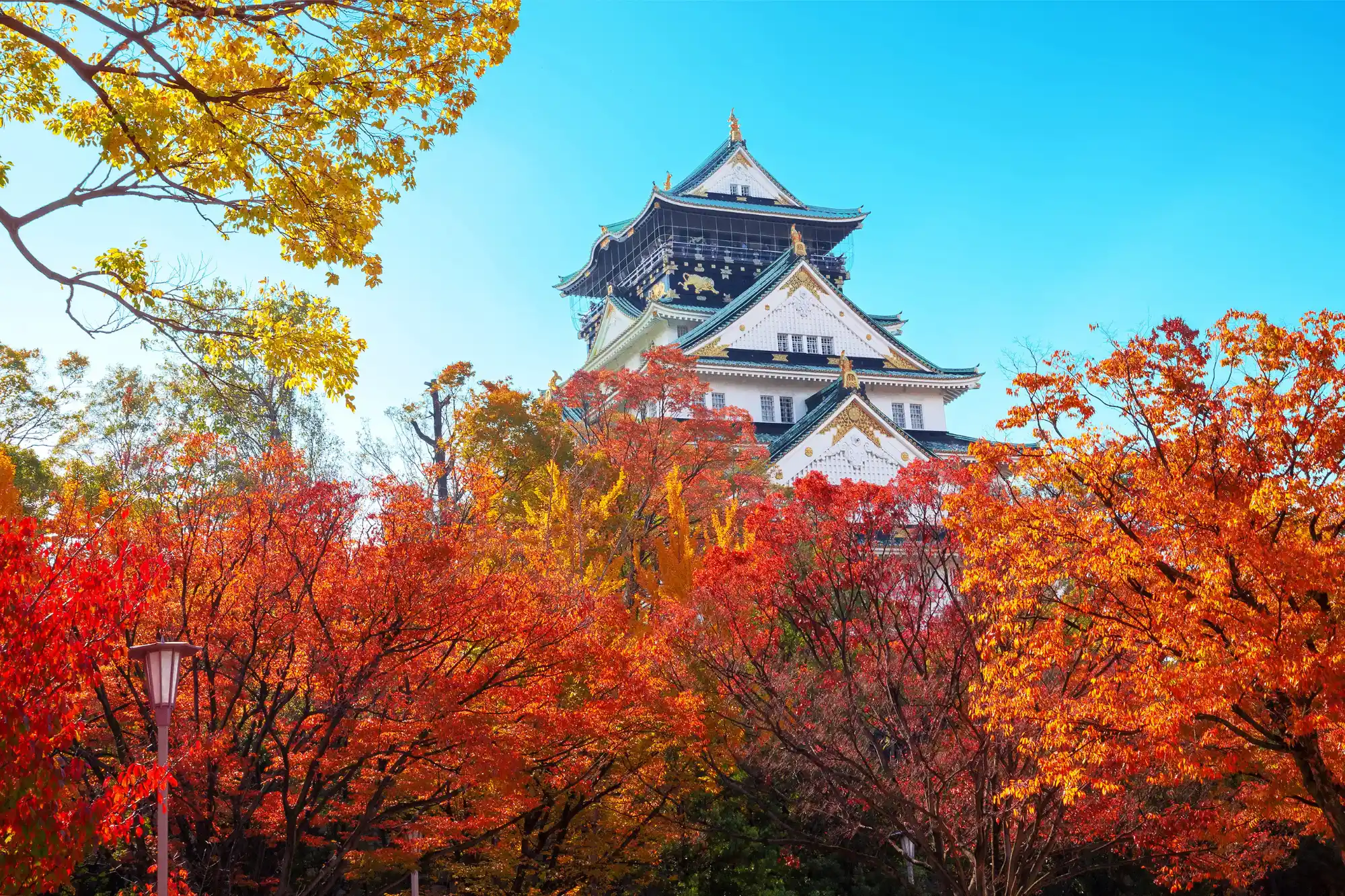
Autumn is widely considered one of the most magical times to explore Japan. With crisp air, clear skies, and a breathtaking backdrop of fiery red maples and golden ginkgo trees, it offers near-perfect travel conditions. However, transitioning from mid-autumn into early winter brings noticeable temperature drops and regional variations that can make packing confusing. This comprehensive Japan autumn weather guide by Nicetrips breaks down October and November temperatures by region, highlights autumn foliage timelines, and provides practical packing strategies to ensure you stay comfortable throughout your journey.
Overview of Japan Autumn Weather 2026
Japan October Weather: Warm days & mild nights
October is one of the most pleasant months to visit Japan, offering mild weather, clear blue skies, and a noticeable drop in humidity after the summer heat.
- Average Temperature: Ranges from 5-22°C (41-72°F), featuring warm daytime sun and mildly cool evenings.
- Weather & Rainfall: Rainfall decreases significantly compared to September, bringing many sunny, dry days perfect for outdoor sightseeing.
- Humidity & Travel Comfort: The crisp, comfortable air makes walking through city streets and traveling between destinations effortless.
- Autumn Foliage Status: Autumn leaves (koyo) begin to change color in Hokkaido, high-altitude mountain ranges, and northern national parks.
Travelling to Japan in October is an ideal choice for travelers who want comfortable weather, wish to avoid summer heat, and want to catch the early signs of autumn.

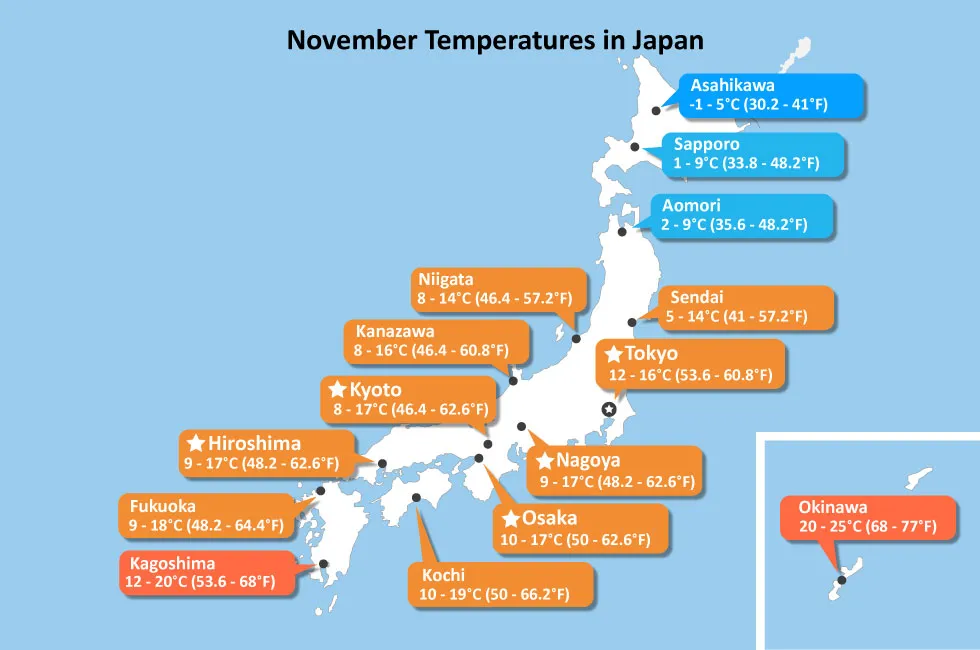
Japan November Weather: Crisp air & peak foliage
November brings a true autumn atmosphere with cooler temperatures, stable weather, and the most stunning Japan autumn leaves scenery of the year.
- Average Temperature: Drops to around -2-18°C (~28-64°F), with brisk, cool daytime weather and chilly mornings and evenings.
- Weather & Rainfall: One of the driest months of the year, boasting bright sunny days and low rainfall ideal for outdoor photography.
- Humidity & Travel Comfort: Cool, crisp fall air requires light jackets during the day and warmer outer layers at night.
- Autumn Foliage Status: Peak foliage season with vibrant red maples and golden ginkgo trees across major cities like Tokyo, Kyoto, Osaka, Nara, and Hakone.
November is the ultimate time to visit if your main goal is to experience Japan’s autumn foliage at its absolute peak.
Japan December Weather: Early winter transition & late foliage
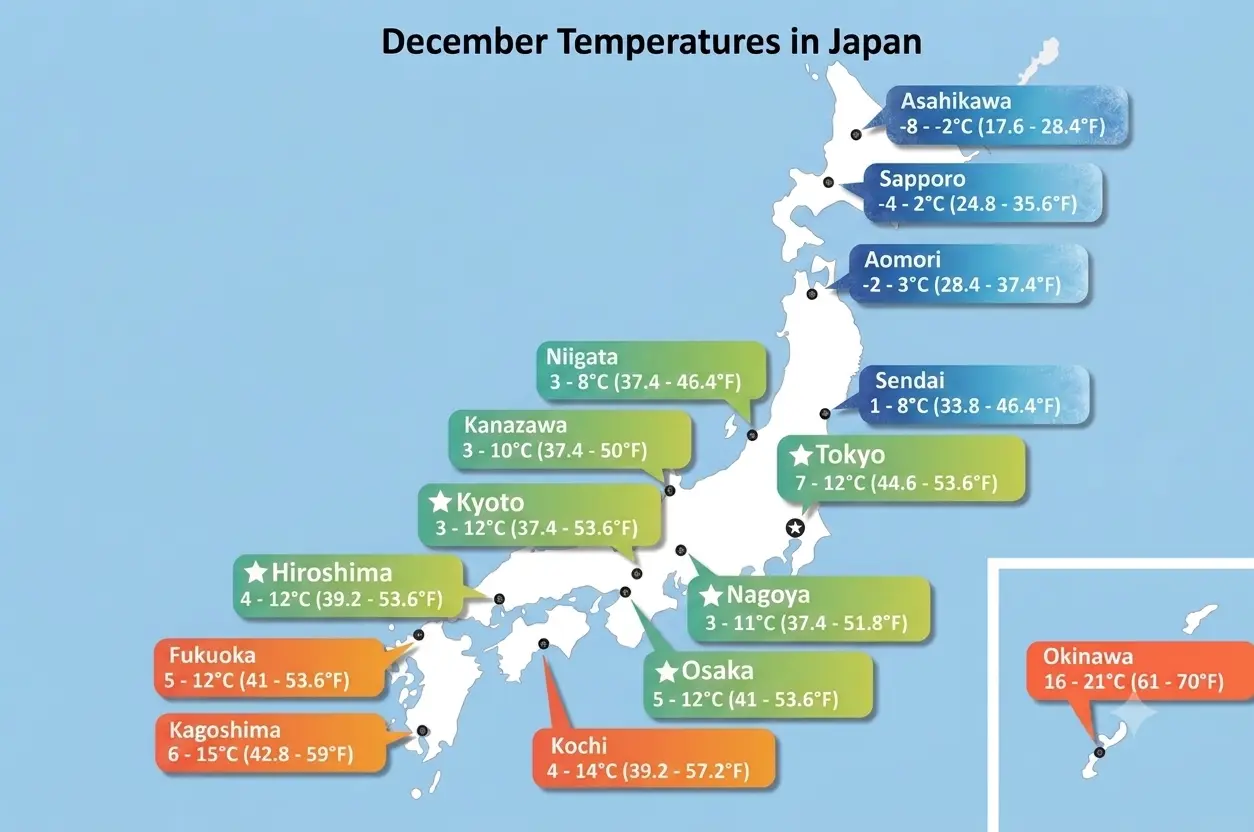
December marks the transition from late autumn into early winter, bringing brisk, frosty air, clear sunny days, and lingering late-season koyo in warmer southern regions.
- Average Temperature: Ranges from -6°C to 12°C (21°F-54°F) nationwide, with chilly daytime temperatures and freezing mornings and evenings.
- Weather & Rainfall: Exceptionally dry and clear weather with frequent sunny days across major central cities, while high-altitude mountains and northern regions begin seeing early snowfall.
- Humidity & Travel Comfort: Low humidity brings crisp winter air, making heavy coats, thermal base layers, and warm accessories essential for outdoor sightseeing.
- Autumn Foliage Status: Late-season foliage continues through early December in southern areas and sheltered spots in Tokyo, Kyoto, and Kyushu, before trees fully shed their leaves.
Travelling to Japan in December is ideal for travelers who want to combine late-season foliage with early winter vibes, festive illuminations, and comfortable, crowd-free sightseeing.
Comparison table: October vs November vs December
Weather Factor | October | November | December |
| Average Temperature | 5°C-22°C (41°F-72°F) | -2°C-18°C (28°F-64°F) | -6°C-12°C (21°F-54°F) |
| Rainfall | Moderate to low | Low | Very low (Dry season) |
| Humidity | 60% – 70% | 55% – 65% | 50% – 60% |
| Typical Weather | Warm days, cool nights, clear skies | Cool, crisp air with chilly evenings | Cold, dry days, freezing nights, clear skies |
| Autumn Foliage | Begins in northern & mountainous regions | Peak season across central Japan | Late foliage in southern zones; transition to winter |
Good to know: Japan autumn weather plays a key role in determining when Japan autumn leaves reach their peak. As temperatures drop below 10°C (50°F), leaves begin turning brilliant shades of red, orange, and yellow. Peak color typically develops after nighttime temperatures fall below 8°C (46°F). Since cooler weather arrives first in northern Japan and mountainous regions before spreading southward, the autumn foliage season unfolds gradually across the country, giving travelers multiple opportunities to experience Japan’s famous koyo. Before planning your autumn trip, check the Japan Autumn Leaves Forecast 2026 to find the best time to see vibrant autumn leaves.
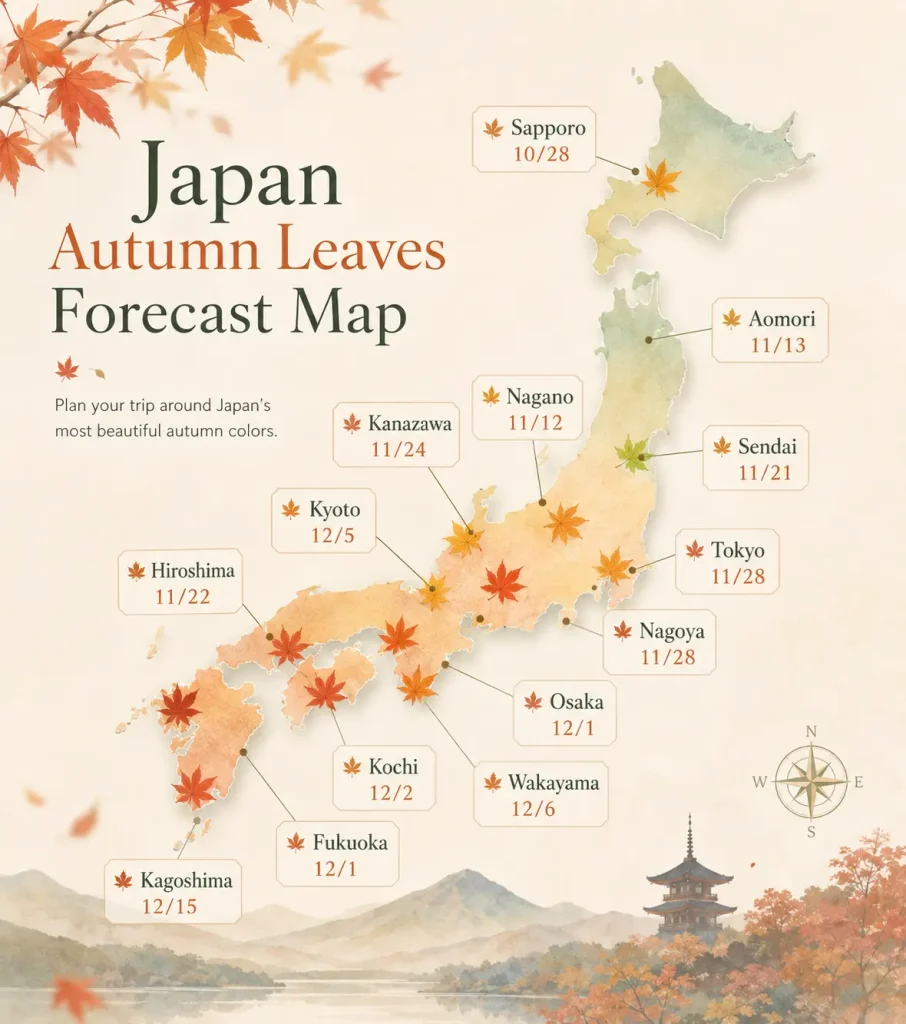
Regional Temperature Breakdown for October, November and December
1. Northern Japan
Northern Japan comprises the island of Hokkaido and the northern regions of Honshu, known as Tohoku (including prefectures like Aomori, Miyagi, and Akita). The landscape is defined by dramatic geography: rugged mountain ranges, vast volcanic national parks, serene crater lakes, and scenic coastline drives. Because of its northern latitude and high-altitude topography, autumn arrives here much earlier than in the rest of the country.
Temperature Data: October averages 12°C-16°C (54°F-61°F); November drops to 1°C-8°C (34°F-46°F). December: Freezes to -6°C-3°C (21°F-37°F).
Weather Impact: Coldest region with rapid temperature drops and early sub-zero nights.
Best Activities:
- October: Mountain hiking, scenic road trips, and early autumn foliage viewing.
- November: Hot spring (onsen) baths, seasonal seafood hotpots, and early snow experiences.
- December: Skiing/snowboarding, winter illuminations, frozen lake sightseeing, and cozy indoor cultural experiences.
Best Suited For: Adventure travelers, nature photographers, and cold-tolerant visitors seeking early winter vibes.
2. Central Japan
Central Japan forms the cultural and economic heartland of the country, encompassing the Kanto region (Tokyo and surrounding areas), the Kansai region (Kyoto, Osaka, Nara, Kobe), and the Chubu region (including Mount Fuji, the Japanese Alps, and Kanazawa). The geography transitions seamlessly from dense, modern metropolis plains to dramatic mountain landscapes and tranquil lakes, such as the Fuji Five Lakes (Fujigoko).
Temperature Data: October reaches 20°C-22°C (68°F-72°F); November averages 7°C-16°C (45°F-61°F). December: Drops to 2°C-12°C (36°F-54°F)
Weather Impact: Ideal Japan autumn weather with mild, sunny days and cool, crisp nights.
Best Activities:
- October: City walking tours, outdoor theme parks, and historic sightseeing.
- November: Peak koyo leaf viewing, temple illuminations, and autumn garden walks.
- December: Winter holiday illuminations, late-season foliage viewing, Mt. Fuji snow-capped views, and hot spring (onsen) retreats.
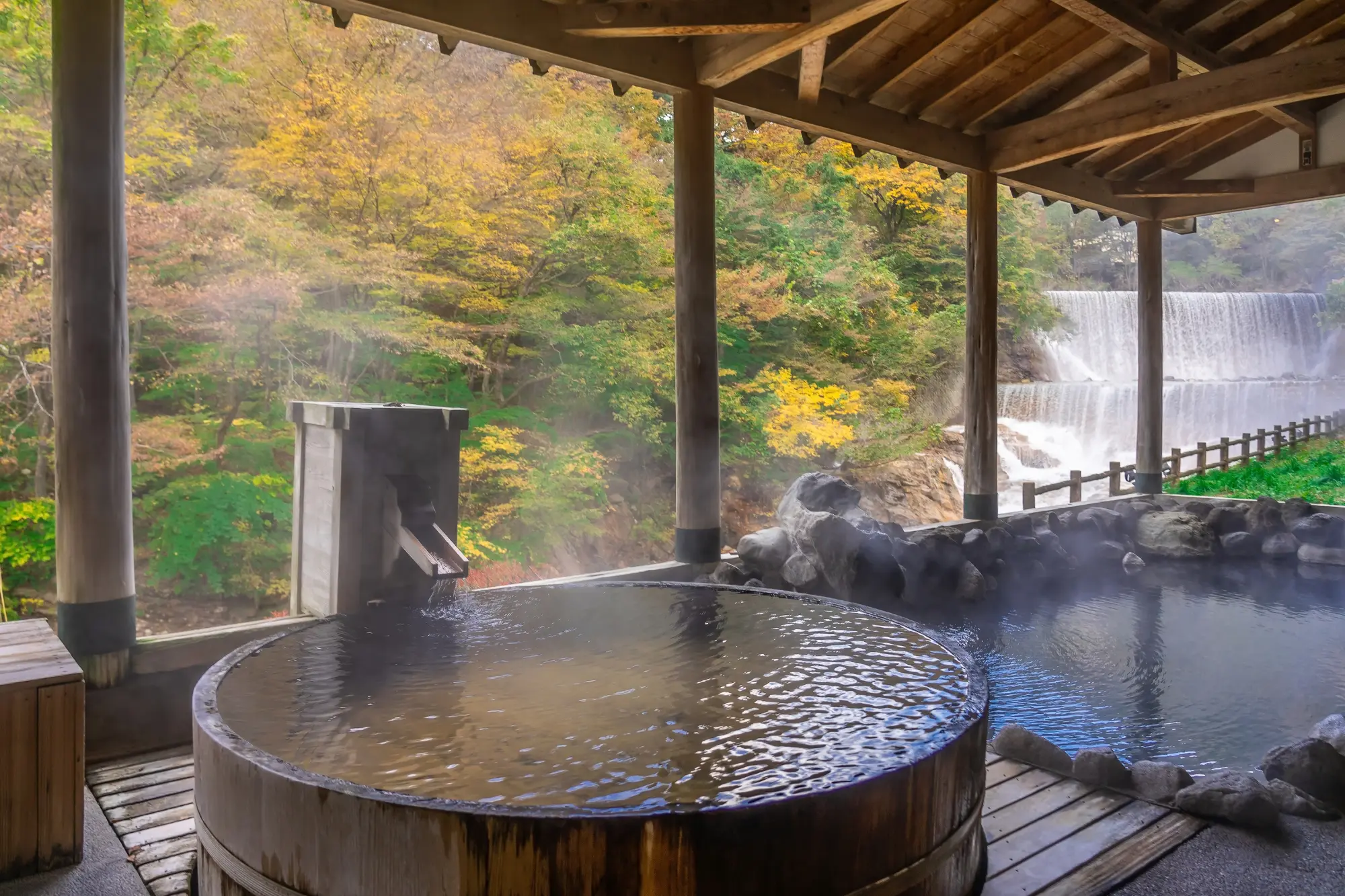
Best Suited For: First-time tourists, families with children, seniors, and general culture lovers.
3. Southern Japan
Southern Japan comprises the island of Kyushu (featuring cities like Fukuoka, Kumamoto, and Nagasaki) and the southern tip of Honshu, including Hiroshima and the Seto Inland Sea. The geography is characterized by coastal plains, lush volcanic terrain, scenic islands, and historic castle towns. Positioned at a lower latitude, this region enjoys the mildest temperatures and longest stretches of sunshine in autumn.
Temperature Data: October highs reach 23°C (73°F); November averages 10°C-19°C (50°F-66°F); December: Cools down to 5°C-14°C (41°F-57°F)
Weather Impact: Warmest region with extended sunshine and very low rainfall.
Best Activities:
- October: Coastal cycling, island hopping, and outdoor street dining.
- November: Exploring open-air food stalls, historic castles, and late-season foliage.
- December: Catching late-season red maples, volcanic hot spring (onsen) tours, and enjoying winter food markets.
Best Suited For: Cold-sensitive travelers, foodies, and active outdoor sports enthusiasts.
Note: Although Japan autumn weather is typically stable, temperatures and rainfall can vary between regions and throughout the season. Before your trip, check the latest forecast for Japan October weather, Japan November weather, or Japan December weather to pack the right clothing and catch Japan autumn leaves at their peak. Nicetrips strongly recommends you verify data at the Japan Meteorological Agency shortly before your departure for the most up-to-date forecasts.
What to wear in Japan in autumn: Smart packing guide
What to pack for October
October offers mild and pleasant conditions, with average Japan October weather ranging from 15°C to 22°C (59°F-72°F). Daytime hours feel warm and comfortable, while late afternoons bring a gentle, cooling breeze.
For daytime sightseeing, breathable cotton long-sleeve shirts, casual tees, and jeans or chinos are ideal. As the sun sets, temperatures drop quickly, making light outerwear essential.
- Recommended Outfits: Long-sleeve tops, cotton shirts, jeans, chinos, or midi skirts with light tights.
- Essential Outerwear: Denim jackets, cardigans, light windbreakers, or casual blazers.
- Packing Strategy: Choose lightweight layers that can easily be folded and stored in your daypack during afternoon walks.
What to pack for November
As true autumn settles in, Japan November weather often decrease to 7°C-16°C (45°F-61°F). Days feel noticeably cooler, and mornings and evenings require proper winter-adjacent insulation, especially when staying outdoors for temple illuminations.
Because buses, trains, and department stores run heavy indoor heating starting in November, wearing easily removable outer layers is key to avoiding overheating indoors.
- Base & Middle Layers: Thermal base tops, fine-knit sweaters, and fleece-lined trousers.
- Essential Outerwear: Trench coats, medium-weight wool coats, or compact down jackets.
- Warm Accessories: Medium-weight wool scarves, light gloves, and warm socks for cold evening strolls

What to pack for December
As late autumn transitions fully into early winter, Japan December weather drop sharply to 2°C-12°C (36°F-54°F) nationwide, with mountain areas and northern regions dipping well below 0°C (32°F). Days are crisp, dry, and cold, while mornings and evenings require heavy winter insulation especially for outdoor illuminations or late-season foliage viewing.
- Recommended Outfits: Thermal base layers (Uniqlo Heattech Ultra Warm), thick-knit sweaters, fleece hoodies, and wool-blend or heat-lined trousers/jeans.
- Essential Outerwear: Heavy wool coats, windproof down jackets, or insulated parka coats with hood protection.
- Warm Accessories: Heavy wool scarves, thermal lined gloves, knitted beanies, and thick wool socks to combat cold pavements during evening walks.
- Packing Strategy: Prioritize windproof outer shells and high-quality thermal underwear so you can stay warm outdoors without carrying an overly bulky wardrobe.
Footwear & essential accessories
Exploring Japan involves a significant amount of walking, so choosing supportive, broken-in footwear is critical for navigating city pavements and temple stone paths. Additionally, Japanese culture frequently requires removing shoes before stepping into traditional locations, including temples, ryokans, and historic castles.
- Footwear Choices: Cushioned walking sneakers or supportive boots with slip-on functionality for easy removal.
- Day Pack & Umbrella: A lightweight compact umbrella for unexpected light rain and a medium daypack to carry extra layers as temperatures shift.
Practical Autumn Travel Tips in Japan
Navigating Japan autumn weather requires a mix of smart packing and strategic itinerary planning. Keeping these practical climate and logistical insights in mind ensures a smooth and comfortable journey throughout the season.
Manage significant Day-to-Night temperature swings
Autumn brings daily temperature fluctuations of 8°C to 10°C (14°F-18°F). Warm afternoon sunshine gives way rapidly to crisp, cold air after dusk. Always pack a compact jacket, scarf, or light layer in your daypack to stay comfortable during evening walks. Besides, in the cold season public transport, trains, department stores, and indoor attractions run powerful heating systems. So that, wearing easily removable outer layers over light base pieces so you can adjust quickly when stepping between chilly outdoor streets and warm indoor spaces.
Plan outdoor activities for early sunrise hours
As winter approaches, daylight hours shrink significantly. By November, sunset occurs as early as 4:30 PM. As a result, to maximize daylight for Japan autumn leaves photography, hiking, and temple gardens, schedule all outdoor sightseeing in the morning and reserve evenings for illuminated parks, indoor shopping, or dining.
Book accommodations and transport early for peak season
November is one of the busiest travel periods in Japan due to peak Japan autumn leaves period. Popular destinations like Kyoto, Hakone, and Fuji Five Lakes see high demand. Secure your hotels, Shinkansen reserved seats, and major attraction tickets well in advance to avoid long lines and sold-out venues.
If you are worried about securing prime hotel locations, navigating complex train routes, or managing tight itineraries during this busy period, Nicetrips has you covered. Beyond curated stays and seamless transport planning, Nicetrips also offers car rental and private charter services for travelers who prefer the flexibility of driving themselves ensuring you can fully enjoy Japan’s breathtaking autumn scenery at your own pace.
Conclusion
Experiencing autumn in Japan is an unforgettable journey through vibrant red maple forests, golden ginkgo avenues, and crisp, invigorating air. Understanding Japan autumn weather patterns allows you to pack smartly, choose the right regional destinations, and catch the peak koyo foliage at its most spectacular.
Don’t forget to visit the Nicetrips Blog to explore useful articles for your upcoming adventures! And if you want a completely stress-free autumn vacation, consider joining a curated Nicetrips Tour Package.