A 14-day trip to Vietnam can cost around $700 – $1,000 for budget travel, $1,200 – $2,000 for a comfortable mid-range trip, or $2,500+ for a premium experience, excluding international airfare. For most international travelers, around $1,200 – $1,600 per person is a practical budget for a comfortable two-week trip. This can cover accommodation, food, transportation, activities, and some flexibility without requiring you to constantly watch every expense. Your actual Vietnam trip cost depends on where you stay, how you travel between destinations, how often you book tours, and how many regions you want to explore. This guide breaks down the costs so you can build a realistic 14-day Vietnam travel budget for 2026.

Quick Answer: How Much Does a 14-Day Trip to Vietnam Cost?
For one person, excluding international airfare, a realistic 2026 budget is:
| Travel Style | 14-Day Budget | What You Can Expect |
| Budget | $700 – $1,000 | Simple hotels, local food, affordable transport |
| Mid-range | $1,200 – $2,000 | 2 – 3-star hotels, restaurants, selected tours |
| Premium | $2,500+ | Upscale hotels, private transfers, premium experiences |
A budget of $1,000 works for travelers who are comfortable with simple accommodation, local restaurants, and carefully planned transportation.
A budget of $1,200 – $1,600 provides more flexibility for private rooms, better-located hotels, domestic flights, and several paid experiences.
If you want upscale hotels, private guides, premium cruises, and private transportation throughout the trip, expect to spend considerably more. For a comfortable 14-day Vietnam trip, plan around $1,200 – $1,600 per person, excluding international airfare.
What Does a 14-Day Vietnam Trip Budget Include?
For this guide, the estimated budget covers your main expenses after arriving in Vietnam:
- Accommodation
- Food and drinks
- Local transportation
- Intercity transportation
- Domestic flights where needed
- Entrance fees
- Tours and activities
- Miscellaneous expenses
- Emergency buffer
International airfare is not included because flight prices vary significantly depending on your departure country, travel dates, airline, and booking time. Visa fees and travel insurance should also be calculated separately where applicable.
How Much Does Accommodation Cost in Vietnam?
Accommodation is usually one of the largest parts of a two-week Vietnam travel budget. With 14 days, you will typically need around 13 nights of accommodation, although this depends on your arrival and departure schedule.
Budget Accommodation: $10 – $30 per Night
Budget travelers can choose from:
- Hostel dorms
- Guesthouses
- Homestays
- Simple private rooms
- Basic hotels
A private room in a budget hotel or guesthouse can often provide considerably more privacy without requiring a large increase in your overall trip budget. For 13 nights, you could spend approximately: $130 – $390. This works well for travelers whose priority is keeping their overall Vietnam trip cost low.
2 – 3-Star Hotels: $30 – $70 per Night
For travelers who want a comfortable private room without spending heavily on accommodation, a 2 – 3-star hotel can be an optimal choice.
At this level, you can generally expect:
- Private bathrooms
- Air conditioning
- Wi-Fi
- Comfortable rooms
- Convenient locations
- Breakfast at some properties
For 13 nights: $390 – $910.
Actual prices vary considerably depending on the destination and season. Hotels in major tourist areas or during peak periods can cost more, while smaller cities may offer better value.
Boutique and Luxury Hotels: $70 – $150+ per Night
Boutique hotels, upscale properties, and luxury resorts can significantly increase your total Vietnam travel budget.
At this level, you may have access to:
- Larger rooms
- Premium locations
- Swimming pools
- Resort facilities
- Higher-end dining
- Personalized services
For 13 nights, accommodation alone can easily exceed $900 – $2,000+.

If accommodation is important to your overall experience, it is often better to choose a few special properties rather than paying premium rates in every destination.
How Much Does Food Cost in Vietnam?
Food is one of the easiest expenses to control during a Vietnam trip.
A practical daily food budget is:
| Travel Style | Daily Food Budget |
| Budget | $8 – $12 |
| Mid-range | $15 – $25 |
| Premium | $30 – $60+ |
For 14 days, this means:
- Budget: around $112 – $168
- Mid-range: around $210 – $350
- Premium: $420 – $840+
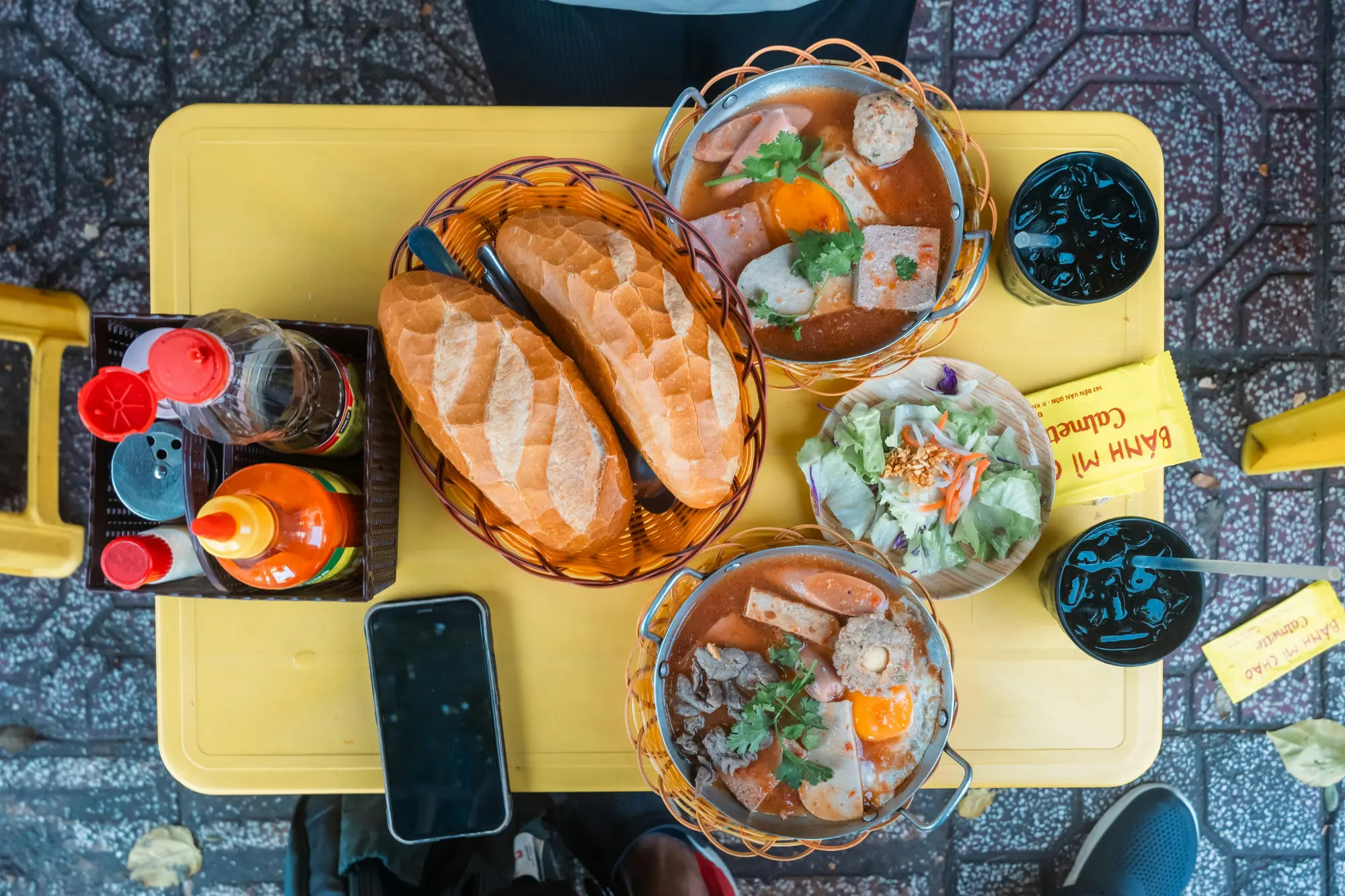
Local dishes such as pho, banh mi, rice dishes, noodles, and regional specialties can often be enjoyed for just a few dollars.You also do not need to eat street food for every meal. A good strategy is to combine: Local food + casual restaurants + occasional special meals. This gives you the opportunity to experience Vietnamese cuisine while keeping your overall spending under control.
What Does a Typical Day of Food Cost?
A comfortable day might look like:
- Breakfast: $3 – $5
- Vietnamese coffee: $1 – $2
- Lunch: $4 – $7
- Dinner: $6 – $10
- Snacks or drinks: $2 – $5
That puts a realistic mid-range food budget at around $15 – $25 per day.
How Much Does Transportation Cost in Vietnam?
Transportation can have a significant impact on your total 14-day Vietnam trip cost, particularly if you want to travel from north to south. Vietnam is geographically long, and a two-week itinerary may involve several flights, trains, buses, and local transfers.
A practical transportation budget is:
| Travel Style | 14-Day Transportation Budget |
| Budget | $80 – $150 |
| Mid-range | $150 – $300 |
| Premium | $400+ |
These estimates can vary significantly depending on your itinerary.
Local Transportation
For getting around cities, you can use:
- Walking
- Public buses
- Grab
- Taxis
- Private transfers
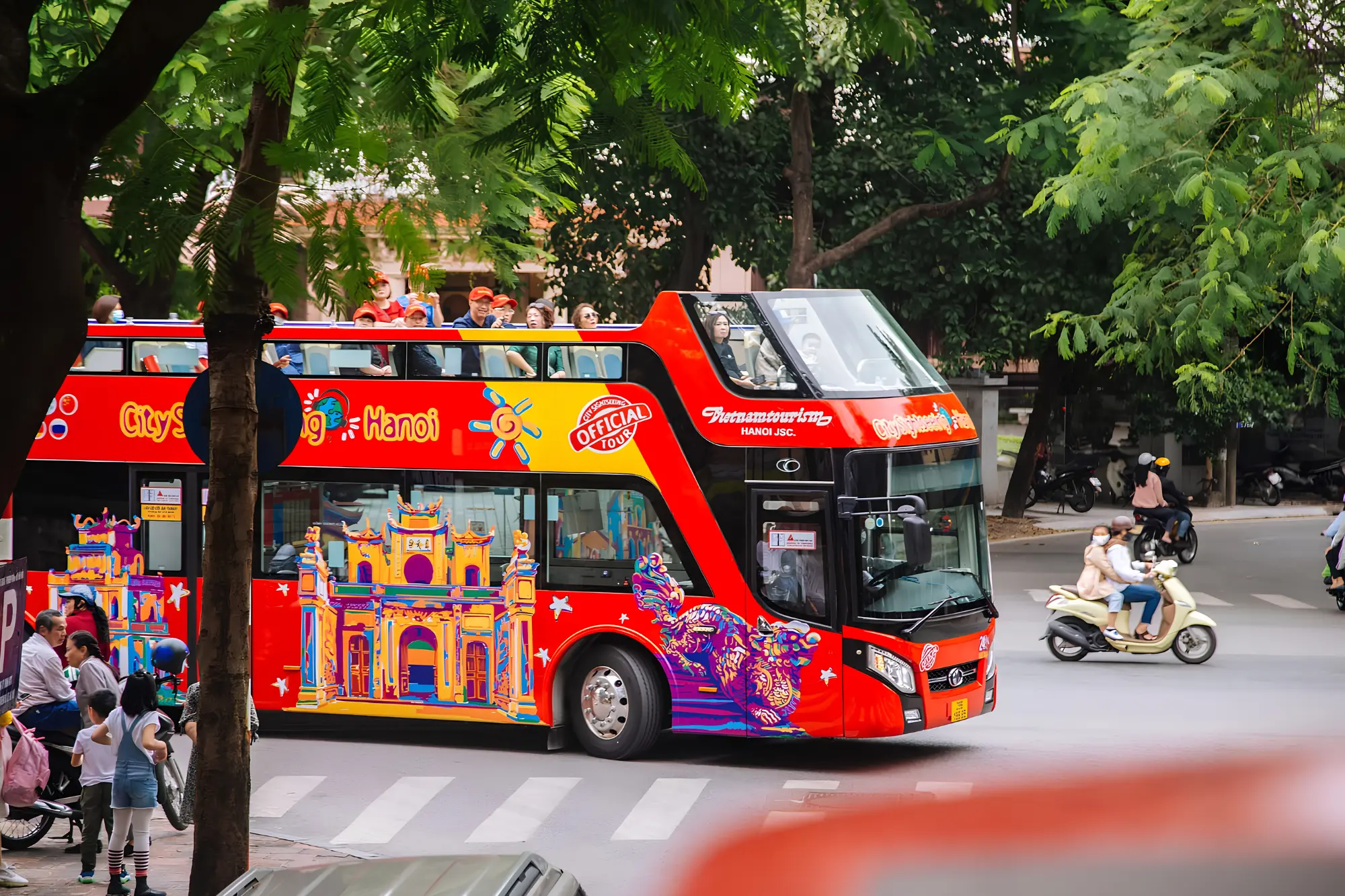
Walking is often the cheapest option in central areas, while Grab provides convenient transportation for longer distances within cities.
Trains and Sleeper Buses
Trains and sleeper buses can be useful for longer journeys.
They can also save the cost of a hotel night when you choose an overnight route, although travel time and comfort should be considered.
Domestic Flights
Domestic flights are useful when you need to cover long distances quickly.
For a 14-day trip, using one or two domestic flights can make a multi-region itinerary much more manageable.
However, flying between every destination can quickly increase your total budget.
The more destinations you add, the more transportation can affect your Vietnam trip cost.
For a two-week trip, a carefully planned route is often more valuable than trying to visit as many places as possible.
How Much Should You Budget for Activities?
Vietnam has plenty of free and inexpensive attractions, but organized tours and premium experiences can increase your spending.
A reasonable activity budget for 14 days is:
$100 – $250 per person
Depending on your itinerary, this could include:
- Ha Long Bay or Lan Ha Bay cruise
- Ninh Binh boat trip
- Cu Chi Tunnels tour
- Mekong Delta tour
- Hoi An cooking class
- Museums
- Cultural attractions
- Guided walking tours
- Local experiences
You do not need to book an organized tour every day.
Instead, choose the experiences that are most important to you and combine them with free sightseeing and independent exploration.
For example, you might spend more on a Ha Long Bay cruise but spend very little on a day exploring Hanoi’s Old Quarter.
Sample 14-Day Vietnam Budget
Here is an example of a comfortable but budget-conscious 14-day trip for one person:
| Expense | Approx. Budget |
| Accommodation – 13 nights | $500 |
| Food & drinks | $250 |
| Transportation | $200 |
| Activities & tours | $150 |
| Miscellaneous | $75 |
| Emergency buffer | $100 |
| Total | $1,275 |
This gives you a realistic $1,275 on-the-ground budget for two weeks.
You could spend less by choosing cheaper hotels and transportation, or considerably more by upgrading accommodation, booking private transfers, or adding premium experiences.
The important point is that you do not need to spend the same amount every day.
A day spent exploring a city independently may cost $40 – $50, while a day involving a cruise or domestic flight could cost $100 or more.
Is $1,000 Enough for 2 Weeks in Vietnam?
Yes, $1,000 can be enough for 14 days in Vietnam if you travel on a budget-conscious plan.
With approximately $71 per day, you can cover accommodation, food, transportation, activities, and miscellaneous expenses if you make careful choices.
A $1,000 budget is most realistic for travelers who:
- Choose affordable private rooms or guesthouses
- Eat mostly local food
- Use trains and buses strategically
- Limit domestic flights
- Choose a few priority tours
- Avoid luxury hotels
- Keep an emergency buffer
For a detailed breakdown of what $1,000 can cover, see our guide to Is $1,000 Enough for 2 Weeks in Vietnam?.
What Does $1,500 Get You for 14 Days in Vietnam?
A budget of $1,500 gives you noticeably more flexibility.
You could comfortably combine:
- 2 – 3-star hotels
- Better hotel locations
- Local and casual restaurants
- Several Grab rides
- One or two domestic flights
- Multiple paid activities
- A quality cruise
- An emergency buffer
You would not need to optimize every single expense.
This is why $1,200 – $1,600 is a useful target for travelers who want comfort without moving into luxury travel.
What Does $2,000 Get You for 14 Days in Vietnam?
With $2,000, you can create a significantly more comfortable trip.
You could consider:
- Better boutique hotels
- 4-star properties
- More domestic flights
- Premium cruises
- Private transfers on selected days
- More restaurant dining
- Additional guided experiences
However, $2,000 still does not necessarily mean luxury everywhere.
If you want 5-star hotels, private guides, premium cruises, and private transportation throughout your journey, your budget may need to be considerably higher.
Does a 14-Day Vietnam Trip Include International Flights?
No. The budgets in this guide exclude international airfare.
This is important because flights can represent a significant part of your total holiday budget.
The cost depends on:
- Your departure country
- Travel dates
- Airline
- Season
- How far in advance you book
- Number of connections
When calculating your complete Vietnam holiday budget, separate your expenses into:
- International airfare
- Visa, if applicable
- Travel insurance
- Accommodation
- Food and drinks
- Transportation inside Vietnam
- Activities and tours
- Miscellaneous expenses
- Emergency funds
This makes it much easier to understand what you are actually spending on the Vietnam portion of your journey.
Is 2 Weeks Enough to Visit Vietnam?
Yes. Two weeks is a good amount of time to experience several parts of Vietnam without having to rush through the entire country.
Unlike a seven-day trip, 14 days gives you more flexibility to combine northern, central, and southern Vietnam.
However, you should still avoid creating an itinerary with too many stops.
Every additional destination means:
- Another hotel change
- Another transfer
- More transportation costs
- More time spent traveling
A well-planned 14-day itinerary should allow enough time to actually experience each destination.
Where Should You Go in Vietnam for 2 Weeks?
Your ideal route depends on your interests and travel style.
Northern Vietnam
A northern itinerary could include:
Hanoi → Ninh Binh → Ha Long Bay
This route combines:
- Vietnamese culture
- Historic landmarks
- Local food
- Limestone landscapes
- River and bay cruises

Central Vietnam
A central route could include:
Hue → Da Nang → Hoi An
This is a strong option for travelers interested in:
- Vietnamese heritage
- Beaches
- Food
- Ancient architecture
- Countryside experiences

Southern Vietnam
A southern itinerary could include:
Ho Chi Minh City → Mekong Delta
This route offers a different side of Vietnam, with:
- Urban culture
- History
- Markets
- Vietnamese cuisine
- River life

A Multi-Region Vietnam Itinerary
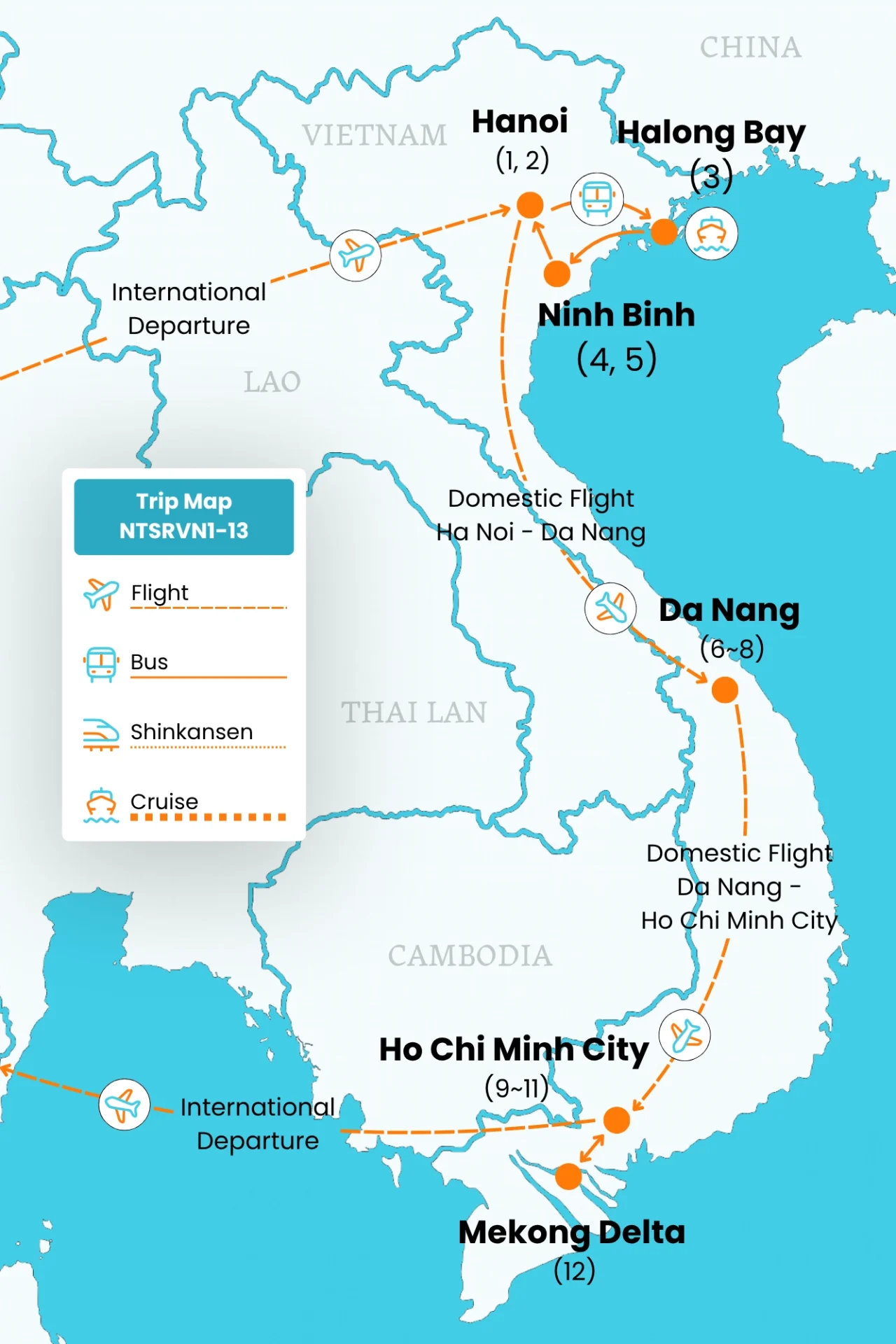
If you want to experience more of the country, a route such as: Hanoi → Ninh Binh → Ha Long Bay → Hoi An → Hue → Ho Chi Minh City → Mekong Delta can work within two weeks if domestic flights are used strategically.
However, this is a relatively active itinerary. If you prefer a slower journey, removing one or two destinations can make the experience more comfortable.
Example: 14-Day Vietnam Itinerary
| Days | Destination | Main Experiences |
| 1 – 3 | Hanoi | Old Quarter, Hoan Kiem Lake, local food |
| 4 – 5 | Ha Long Bay | Trang An, countryside, Bai Dinh Pagoda |
| 6 – 7 | Ninh Binh | Overnight cruise, limestone landscapes |
| 8 – 10 | Da Nang – Hoi An | Ancient Town, food, countryside |
| 11 | Ho Chi Minh City | Imperial City, local culture |
| 12 – 14 | Mekong Delta | History, markets, local food |
This route provides a mix of northern, central, and southern Vietnam while keeping the number of hotel changes relatively manageable. A domestic flight between regions can save considerable travel time.
If you prefer a slower pace, consider focusing on two regions rather than trying to cover the entire country.
Recommended Tour: 13-Day Through Vietnam: Capital Hanoi, Ha Long Bay, Ancient Hoi An and the Mighty Mekong Delta
How to Save Money on a 14-Day Vietnam Trip
Stay Longer in Fewer Places
Moving every one or two days can increase transportation costs and leave less time to enjoy each destination.
Staying three or four nights in one place can often provide better value.
Choose 2 – 3-Star Hotels
A 2 – 3-star hotel can offer a good balance of comfort and affordability.
You can have a private room, air conditioning, Wi-Fi, and a convenient location without spending most of your budget on accommodation.
Eat Local
Vietnamese local restaurants are one of the easiest ways to keep food costs manageable.
Mix local dishes with casual restaurants and save more expensive dining experiences for occasions that genuinely matter to you.

Use Transportation Strategically
Do not automatically choose the cheapest transportation.
For a two-week trip, an inexpensive overnight train can make sense. But a domestic flight may be worth the extra cost if it saves most of a day of travel.
The best approach is to consider both price and time.
Book Major Transportation Early
Planning your major intercity journeys in advance can make your overall budget more predictable.
This is particularly useful if your itinerary requires domestic flights.
Keep an Emergency Buffer
Avoid planning to spend every dollar of your budget.
Keeping $100 – $150 aside gives you flexibility for unexpected transportation changes, additional nights, meals, or other expenses.
Should You Plan Your 14-Day Vietnam Trip Yourself or Book a Tour?
Planning independently can be a good option if you enjoy researching hotels, comparing transportation, and building your own itinerary.
However, a two-week journey across multiple regions can involve a lot of coordination. Hotels, domestic flights, airport transfers, trains, tours, and activities all need to fit together.
A customized trip can be particularly useful if you want to explore several regions while maintaining a comfortable pace.
If you prefer to spend your time experiencing Vietnam rather than coordinating every hotel, transfer, and activity, Nicetrips can create a customized journey around your destinations, interests, preferred pace, and travel style. Explore Vietnam with Nicetrips , tailored to your journey.
Final Thoughts: How Much Does a 14-Day Trip to Vietnam Cost?
So, how much does a 14-day trip to Vietnam cost?
For one person, excluding international airfare:
- Budget: around $700 – $1,000
- Mid-range: around $1,200 – $2,000
- Premium: $2,500+
A $1,000 budget can work if you prioritize affordable accommodation, local food, and carefully planned transportation.
For a more comfortable experience, $1,200 – $1,600 is a more practical target for most travelers.
The key is not simply to spend as little as possible. Instead, decide which parts of the journey matter most to you and allocate your budget accordingly.
With two weeks, you have enough time to experience several sides of Vietnam , from the cultural streets of Hanoi and limestone landscapes of Ninh Binh to the heritage of Hoi An and the energy of Ho Chi Minh City, without having to rush through every destination.

Frequently Asked Questions
How much money do I need for 14 days in Vietnam?
For one person, plan around $700 – $1,000 for budget travel or $1,200 – $2,000 for a comfortable mid-range trip, excluding international airfare.
Is $1,000 enough for 2 weeks in Vietnam?
Yes. $1,000 can be enough for 14 days in Vietnam if you choose affordable accommodation, eat mostly local food, use transportation strategically, and limit expensive tours.
Is $1,500 enough for 2 weeks in Vietnam?
Yes. $1,500 is a comfortable budget for many travelers and allows more flexibility with accommodation, restaurants, transportation, and activities.
How much does Vietnam cost per day?
A practical budget is around $50 – $70 per day for budget-conscious travel and approximately $85 – $140 per day for comfortable mid-range travel, excluding international airfare.
Is 2 weeks enough to visit Vietnam?
Yes. Two weeks is enough to experience several major regions of Vietnam, although it is better to choose a focused route rather than trying to see every destination.
How much does accommodation cost in Vietnam?
Accommodation can range from around $10 – $30 per night for budget options to $30 – $70 for many 2 – 3-star hotels, while boutique and luxury properties can cost $70 – $150 or more.
How much should I budget for food in Vietnam?
A budget traveler can spend around $8 – $12 per day, while a more comfortable food budget is approximately $15 – $25 per day.
Are domestic flights expensive in Vietnam?
Domestic flights can be relatively affordable, but prices vary by route, travel date, and booking time. They can be worthwhile during a two-week trip when they save significant travel time.
Does a 14-day Vietnam budget include international flights?
No. The budgets in this guide cover expenses inside Vietnam. International airfare, visa fees where applicable, and travel insurance should be calculated separately.
What is the cheapest way to travel around Vietnam?
Using a combination of trains, sleeper buses, local transportation, and occasional domestic flights can help keep transportation costs under control. The best option depends on your route and how much time you have.